|
31/8/2026 Why I Won't Chant “F*** the Fascists” at Music Festivals(And a more effective way to change the world)Read Now  I’ve had the most wonderful summer of music: I’ve travelled the country to attend various gigs and music festivals. I had the privilege of attending the All Ireland Fleadh held this year in my home city of Belfast for the first time - something that would never have been possible when I was growing up in the thick of the Troubles. So many of the artists I had the pleasure to listen to touched me deeply with their music: I laughed, I danced and I cried. At times the hairs stood up on the back of my neck and I felt shivers down my spine. I feel immense gratitude for the musicians who showed up with authenticity, willing to share their vulnerabilities with the world. Many of these artists used their platforms to speak out against war and injustice happening in the world today. We absolutely need artists to give voice to those who have been silenced or ignored. We all need to speak up when we can. In Belfast, the Fleadh showed me how music, dance, language and culture can bring people together. It proved we have far more in common than we have differences. I wept in the streets of Belfast witnessing my culture being openly and warmly expressed and welcomed in a city that has seen such conflict on its streets - it gave me renewed hope in humanity. Throughout the summer at the various festivals and gigs I attended there was one element that I couldn’t get on board with. I stood in the crowd as some artists lead the crowd in chants of “F*** the Fascists”, “F*** Trump” and “Death to the IOF” As a parent and an advocate for connection and compassion, these chants didn't sit well with me. The Illusion of Good vs. Evil in Modern ActivismThese chants reinforce a dangerous binary of good versus evil, us versus them, we are virtuous and right whilst they are wrong While the anger behind the words is understandable given the atrocities happening in the world, reducing the complex issues down to these chants creates the very division, othering and dehumanisation that drives us further apart. Instead of shouting down the fascists or those we don't agree with, what if we tried to understand them first? What if, instead of writing them off as entirely evil, we chose curiosity over condemnation? Why Seeking to Understand is Not CondoningTo be absolutely clear: understanding is not the same as excusing. Seeking to understand bigotry does not mean condoning violence or accepting hate speech. Rather, it means recognising that extremists are not a different species born entirely without humanity - as difficult as that is to acknowledge. They are people, moulded by fear, conditioning and isolation. Recognising this doesn't excuse them, it helps us understand how hate grows so we can effectively do something about it. I believe all humans are inherently good, and I also believe we all have the potential to do terrible things under the right circumstances. Moving away from the "I’m right, you’re wrong" belief system invites me to look inward. It requires me to take responsibility for my own prejudices, my judgements, and the moments I have acted outside my own integrity. Conscious Parenting: A Better Way to Change the WorldWatching the crowd chant along, I couldn’t help thinking to myself: What is this achieving? Is there a more effective way to bring about lasting change in our very dysfunctional world? It is easy to feel overwhelmed by global problems and feel too powerless to fix them. But we can start small, right in our own little corner of the world. We can start by bringing the change we want to see in the world into our parenting. "Start where you are. Use what you have. Do what you can." — Arthur Ashe As parents, we know that labelling a child as "bad" never fixes their behaviour. It completely misses the unmet need or the pain driving it. We find much more success when we get curious about why our child is hitting, screaming, or shutting down. When we operate from the belief that children are doing the best they can with the tools they have in the moment, we naturally approach them with empathy. Often, simply helping a child feel seen, heard, and understood is enough to shift a difficult behavioural pattern. At the very least, it creates the calm required to find a solution. This is how the cycle shifts. When we model curiosity and empathy instead of judgement and blame, it becomes our children's blueprint for navigating the outside world. They, too, will learn to seek understanding instead of jumping to judgement. By showing true respect to our children, we teach them how to respect those around them. This isn’t about being the perfect parent. We can also model how to handle conflict maturely and how to repair a relationship when we mess up. These micro-interactions set a lifelong template for empathetic, caring relationships. The ripple effect is huge. A Quiet Revolution in Connected ParentingWith so much wrong in the world it encourages me to know that there is a quiet revolution happening in homes across the world right now. A growing number of parents are no longer willing to rely on the old tools of "power over" and control. Instead, they are learning how to parent with connection and collaboration. This generation of children will go out into the world equipped with emotional intelligence, resilience, and a strong sense of justice and integrity. Connected parenting means bringing these values into every single interaction we have, even the highly polarised ones. By walking our walk and refusing to dehumanise those we disagree with, we model true, active compassion. Empathy vs. Passivity: Setting Firm BoundariesOur duty as parents is to practice radical honesty with ourselves and show profound empathy to others, while still holding rock-solid boundaries against harmful actions. We can validate someone's basic humanity while firmly rejecting their destructive behavior.
Admittedly, in the mundane, repetitive, everyday tasks of parenting, it can often feel like we are doing nothing at all. Comforting an upset child, managing tantrums, and repeating yourself for the hundredth time doesn't feel like activism. But in fact, every single time we choose respect over control, and kindness over harshness, we are doing something deeply profound. It is all these small, invisible actions and daily choices that add up to something much bigger. That realisation gives me immense hope that we have the power to change the world for the better. If we want to create a more peaceful world, we must stop trying to shout down our enemies. We must start doing the hard work of understanding them. That revolution begins at home, by ensuring our own children feel seen, heard, and valued. If this article resonates with you, but your daily reality feels more like chaos and crowd control, I would love to help. If you are ready to do the inner healing work that brings presence, connection, and alignment to your parenting, I invite you to take the first step with me. Let's explore how Dr. Gabor Maté’s Compassionate Inquiry approach can support your family. 18/9/2025 Child Disrespectful? Why ‘Show Some Respect’ Really Means Obedience (And What to Do Instead)Read Now  Why Parents Demand Respect From Their Kids
When a child talks back, ignores a request, or uses a rude tone, many parents feel the urge to say: “Show me some respect!” But what we often mean in that moment isn’t respect, it’s obedience. And if we’re honest, sometimes what we’re really asking for is compliance through fear. Respect vs. Obedience: What’s the Difference?
When we confuse obedience with respect, we risk damaging the trust between us and our children. Why Kids Seem Disrespectful (Rude Behaviour Explained) When children ignore us, refuse to tidy their room, or speak rudely, it can feel personal. But beneath that behaviour is usually something deeper:
If we only focus on the behaviour, demanding “respect” through compliance, we miss the chance to understand what’s driving it. How to Teach Respect Without Fear Inside my Peaceful Parent School, we encourage parents to build respect through connection, not control. Here’s how:
The Parenting Shift That Changes Everything The next time you feel like saying, “Show me some respect,” pause and ask yourself:
Build Respectful, Connected Relationships With Your Child At Peaceful Parent School, I help parents move beyond power struggles into calmer, more connected relationships with their children. If your child’s “disrespectful” behaviour is leaving you frustrated, you’re not alone and there is another way forward. 👉 Learn more about Peaceful Parent School here and discover how to raise your child with respect, without fear. 5/5/2023 Why Every Parent Needs a Listening Partnership to Become an Emotionally Mature ParentRead Now  Parenting can be an incredibly rewarding experience, but it can also be incredibly challenging. Whether you are a new parent or have been parenting for years, you may sometimes feel like you're at a loss for what to do when your child is upset, anxious, or acting out.
That's where Hand in Hand Parenting's Listening Partnerships come in. Listening Partnerships are a powerful tool that can help parents navigate the ups and downs of raising children. In this blog post, we'll take a closer look at what Listening Partnerships are, how they work, and why they can be so beneficial.
Parenting lays the foundation of who our children become and how they will interact in the world.
Imagine if parents could be supported to heal their collective trauma and create a generation who could change the world. Imagine a parenting approach that gives parents the emotional resources and practical tools they need to align their parenting with their values. Imagine if parents and children could heal from their past hurts, build emotional resilience and strengthen the parent-child relationship. Imagine if this enabled parents to prepare their children for the challenges of our times and give them the tools to make a better world inevitable. I was delighted to take part in the Imagine Festival of Ideas. Below is the recording of the full workshop.  What kind of limit setter are you? I invite you to think about what your default limit setting approach is. Here are a few I came up with. 1. Explain 20 times, run out of patience when no one listens and then snap. 2. You set limits harshly or with a very stern tone, sounding exactly like how your own parents set limits with you. 3. You workaround your child's big feelings and upsets to avoid conflict at all costs. That means you often go to great lengths to keep everyone happy, even when it starts to get ridiculous. 4. Maybe your parents were super strict and you are determined to do things differently. So you don't set any limits at all through fear of upsetting your child or being unfair to them. However, maybe that means life is a little chaotic and you aren't getting your own needs met. Of something else? I definitely bounce between all of these strategies from day to day and moment to moment. But when I step out of my "auto-pilot parenting" I use the Hand in Hand Parenting approach to setting limits: Listen - assess the situation, is the limit necessary, is your child's behaviour off-track? Limit - bring the limit with connection and warmth Listen - This is the crucial bit, listen to any feelings that come up. This will allow your child to release emotional tension and get back to being relaxed and flexible. 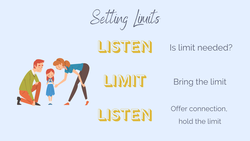 No to the behaviour, yes to the feelings.
This will allow you to set limits in a way that builds relationship and emotional intelligence. Find out more in this week's podcast Epidsode 21 of Peaceful Parenting with Pam.  How should you respond when your child tells you “I hate myself”?
Your sweet child who you love more than life itself. Who you have poured your love and attention on since they were so small. Who you’ve supported through the happy times and life’s challenges. You want the best for them, you want them to be happy. So these words coming from their lips can be devastating. Often our ‘auto-parent response’ might be to talk them out of it, to reassure them, to tell them not to be so silly or to react harshly, telling them not to think those thoughts. What a child needs at this moment is to be heard and understood. To know you are there to listen without judgement (even if you feel like dying inside).  Listen: Five Simple Tools To Help You Meet The Everyday Challenges of Parenting by Patty Wipfler and Tosha Schore is an excellent introduction to the Hand in Hand Parenting approach. The book clearly outlines the five Hand in Hand listening tools: Listening Partnerships, Special Time, Playlistening, Staylistening and Setting Limits.
These simple yet profound parenting tools give parents the strategies they need to implement the theory of gentle, attachment-based parenting in their families.  When mealtimes feel hard, try these kind ideas to help. They work even if your child is super strong-willed or very picky.
When my sweet toddler moved from her high chair to sit with us at the table, I shared her excitement. I felt proud at how grown up she had become. But then she discovered freedom and our mealtimes changed. No longer stuck in her high chair, she began jumping down from her seat at will and running around the table. It was cute and fun at first as she made laps of the table, full of giggles. But before long, more time was spent roaming the kitchen than sitting at the table. She insisted she needed to:
So, my negotiations and pleas continued and soon she wouldn’t sit at the table at all. Food would go uneaten yet twenty minutes later she was begging for snacks. Clearly, mealtimes were not working but I didn’t know what to do about it. "Don't ask why the addiction, but why the pain"
I was deeply honoured to interview Dr Gabor Mate on behalf of @ascertni in our seminar on childhood trauma and addiction. He covers a range of topics including childhood trauma and the impact that has on our adult lives, how to support loved ones affected by addiction, the importance of connection in parenting and the impact of Covid on lives and society. It was a pure joy to speak to this wise gentleman. Full interview above.  A few year’s back when my daughter was about four years old, a new family moved into our neighbourhood and their two children started to play in our back garden. One child was the same age as my daughter and her big brother was about four years older. The trampoline in our garden was a big attraction and the three children started bouncing on it happily. I noticed that the older boy was jumping quite aggressively, diving on purpose into his sister and pinning her to the ground. She shrieked in protest but he refused to get off her and laughed at her attempts to free herself. He was the only one enjoying the game. Before I had time to intervene my own daughter took matters into her own hands. She got down to the boy’s level and shouted “No means no. If someone says “STOP” you have to stop.”  My first year of motherhood felt a bit like trying to stay in control of a runaway train. Breastfeeding did not come easily to me and so I was delighted to reach the milestone of feeding my daughter for a full year.
But I had grown to hate breastfeeding. My daughter was feeding throughout the night almost every hour, sometimes more. She breastfed only occasionally during the day but as soon as nighttime came the 24-hour diner was very much open for business. We were co-sleeping and she seemed to be permanently attached to me. I had forgotten what deep sleep felt like.  Last December my husband and I had two weeks off work.
In previous years we had planned lots of holiday activities, day trips and overnight stays with friends and family. It had all been a little too busy and overwhelming for both us and the children, and so this year we decided we would hibernate at home and make very few plans. We all had time to wind down. My husband and I were feeling relaxed and resourced enough to get playful with our daughter, aged eight, and our son, aged four. One night towards the beginning of the holidays, I suggested we have a family wrestle before bed. We used a spare mattress on the floor as our wrestling arena, and we made the rules up as we went along but it went something like this:  My eight-year-old daughter came home from school this week asking if she was going to catch Coronavirus.
Her school Principal had spoken to her class about Coronavirus and the new procedures they were putting in place for children to wash their hands before lunch and break time. Although I was following the news carefully trying to make sense of the Coronavirus outbreak myself, I had not discussed it with my daughter. It had no direct relevance to her life at that point and I did not want to alarm her unnecessarily. However, now that it was moving closer to home I knew it was time to talk about it. |
Pamela QuieryPamela works with parents, supporting them as they strive to raise conscious, respectful children. Archives
August 2026
Categories
All
|
 RSS Feed